


What is Semana Santa in Spain? Traditions Explained
What is Semana Santa in Spain?
Semana Santa (Holy Week) is one of the most important religious and cultural events in Spain. Celebrated in the week leading up to Easter Sunday, it commemorates the final days of Jesus Christ’s life, including his arrival in Jerusalem, crucifixion, and resurrection.
Across the country—from cities like Seville to coastal towns such as Gandía (Gandia)—Semana Santa is marked by large-scale processions, traditional music, and centuries-old customs. While it is rooted in Catholic faith, it has also become a major cultural event that attracts visitors from around the world.
The Traditions of Semana Santa
At the heart of Semana Santa are the processions, organised by religious brotherhoods known as cofradías. These groups often date back hundreds of years and play a central role in preserving tradition.
Each brotherhood prepares all year for Holy Week. Their processions include:
- Large religious floats (pasos)
- Statues depicting scenes from the Passion of Christ
- Musicians and drummers
- Members dressed in traditional robes
The floats are often carried by teams of people walking in unison, sometimes for hours at a time. The atmosphere can vary from deeply solemn to highly emotional, depending on the day and location.
The Costumes and the Pointed Hoods
One of the most striking aspects of Semana Santa is the clothing worn by participants.
Members of the brotherhoods wear traditional robes and tall pointed hoods called capirotes. These figures are known as nazarenos. While the appearance may seem unusual to visitors, the meaning is deeply symbolic.
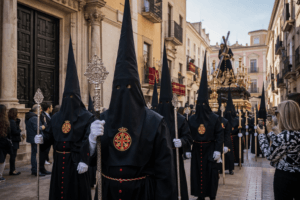
The robes and hoods represent:
- Penance and humility
- Anonymity before God
- Devotion and reflection
The pointed hats are not related to any modern or political symbolism—they date back centuries and are an important part of Spanish religious tradition.
Different brotherhoods wear different colours, making it easy to distinguish them during processions.
The Processions
Semana Santa processions take place throughout the week, often lasting several hours and moving slowly through the streets.
Key elements include:
- Pasos (floats): Highly detailed religious scenes
- Nazarenos: Walking in long lines, often carrying candles
- Bands: Playing slow, dramatic music
- Public participation: Crowds gather to watch and follow
In many towns, the narrow streets and historic settings enhance the experience, creating a powerful atmosphere that combines sound, movement, and tradition.
Key Days of Semana Santa
🌿 Palm Sunday (Domingo de Ramos)
Palm Sunday marks the beginning of Semana Santa.
It commemorates the arrival of Jesus into Jerusalem, where crowds welcomed him by laying palm branches in his path. In Spain, this is recreated with processions where participants carry palm leaves and olive branches.
Children often carry intricately woven palms, which are sometimes blessed before the procession. The atmosphere on this day is usually more celebratory and family-oriented compared to the rest of the week.
Please Subscribe to the Channel. Its free to subscribe and see more great videos !
Please Subscribe to the Channel. Its free to subscribe and see more great videos !
✝️ Good Friday (Viernes Santo)
Good Friday is one of the most important and solemn days of Semana Santa.
It marks the crucifixion and death of Jesus Christ, and many of the processions on this day are designed to tell that story in a visual and symbolic way.
Throughout Spain, the religious floats (pasos) often depict key moments from the Passion, including:
- Jesus carrying the cross
- The crucifixion
- Scenes of suffering and sacrifice
- The mourning of the Virgin Mary
These processions move slowly through the streets, allowing people to reflect on each scene as it passes. The atmosphere is often quiet and emotional, with dim lighting, slow music, and sometimes even complete silence from the crowd.
The combination of detailed imagery, movement, and music creates a powerful storytelling experience. Even for those unfamiliar with the religious background, it becomes clear that these parades are not just displays—they are living representations of the final moments of Christ’s life.
In many towns, Good Friday processions take place late into the evening or at night, adding to the intensity and atmosphere of the occasion.
Please Subscribe to the Channel. Its free to subscribe and see more great videos !
Please Subscribe to the Channel. Its free to subscribe and see more great videos !
🌅 Easter Sunday and the “Glorious Encounter”
Easter Sunday celebrates the resurrection of Jesus Christ, marking the joyful conclusion of Semana Santa.
One of the most distinctive traditions in many Spanish towns, including Gandía (Gandia), is the “Encuentro Glorioso” (Glorious Encounter). This symbolic event represents the moment when the Virgin Mary meets the resurrected Christ.
Typically, two separate processions move through the streets—one carrying the image of the Virgin Mary, often dressed in black to represent mourning, and the other carrying the risen Christ. They eventually meet in a central square, where the “encounter” takes place.
At that moment, the atmosphere changes dramatically:
- Music becomes joyful and uplifting
- Church bells may ring
- The crowd reacts with celebration
In many places, the black veil worn by the Virgin Mary is removed, symbolising the transition from sorrow to joy.
A particularly special and local tradition is the throwing and sharing of sweets and small gifts, especially for children. As the celebration unfolds, sweets may be handed out or even thrown into the crowd, adding a festive and family-friendly element to the occasion.
This joyful moment contrasts strongly with the solemn tone of the previous days, bringing Semana Santa to a close with a sense of happiness, renewal, and community.
Please Subscribe to the Channel. Its free to subscribe and see more great videos !
Please Subscribe to the Channel. Its free to subscribe and see more great videos !
Why Semana Santa is So Special
Semana Santa is more than just a series of religious events—it is a reflection of Spain’s history, culture, and identity.
For locals, it represents:
- Faith and devotion
- Community and tradition
- A connection to the past
For visitors, it offers a unique opportunity to experience something authentic and deeply rooted in Spanish life.
Whether you are watching a quiet procession on Good Friday or a colourful parade on Palm Sunday, Semana Santa provides a powerful insight into one of Spain’s most important annual traditions.
📍 Final Thoughts
If you are planning to visit Spain during Easter, experiencing Semana Santa is something you should not miss. Each town and city has its own unique style, but all share the same sense of history and meaning.
From the first palms of Domingo de Ramos to the joy of the Glorious Encounter on Easter Sunday, Semana Santa is a journey through tradition, emotion, and culture that stays with you long after it ends.
Pingback:Gandía (Gandia) Good Friday: Holy Burial Procession
Pingback:El Encuentro Glorioso de Gandía de Semana Santa