


Mediterranean Sea Temperatures Reach Record Levels in 2026
The Mediterranean Sea has been exceptionally warm during 2026, with record and near-record temperatures recorded across large areas of the basin and along parts of the Spanish coastline.
For people living on Spain’s Mediterranean coast, the difference is more than just a number on a weather chart. The unusually warm sea is contributing to increasingly warm and humid coastal conditions, while the Mediterranean itself is experiencing one of its most remarkable periods of marine heat in recent years.
What makes 2026 particularly interesting is that the exceptional temperatures did not suddenly appear during the height of summer. The Mediterranean was already unusually warm during May, and temperatures increased further during June and July.
Record sea temperatures were already being recorded in May
Some of the most remarkable figures were recorded before the start of the meteorological summer.
Spain’s Puertos del Estado monitoring network recorded exceptionally high sea temperatures at numerous locations during May. The Valencia buoy reached 23.47°C on 31 May, setting a record for that month. Other monitoring stations were even warmer, with the Tarragona offshore buoy reaching 24.64°C, Dragonera in Mallorca reaching 26.20°C and Mahón in Menorca reaching an extraordinary 26.58°C on 27 May.
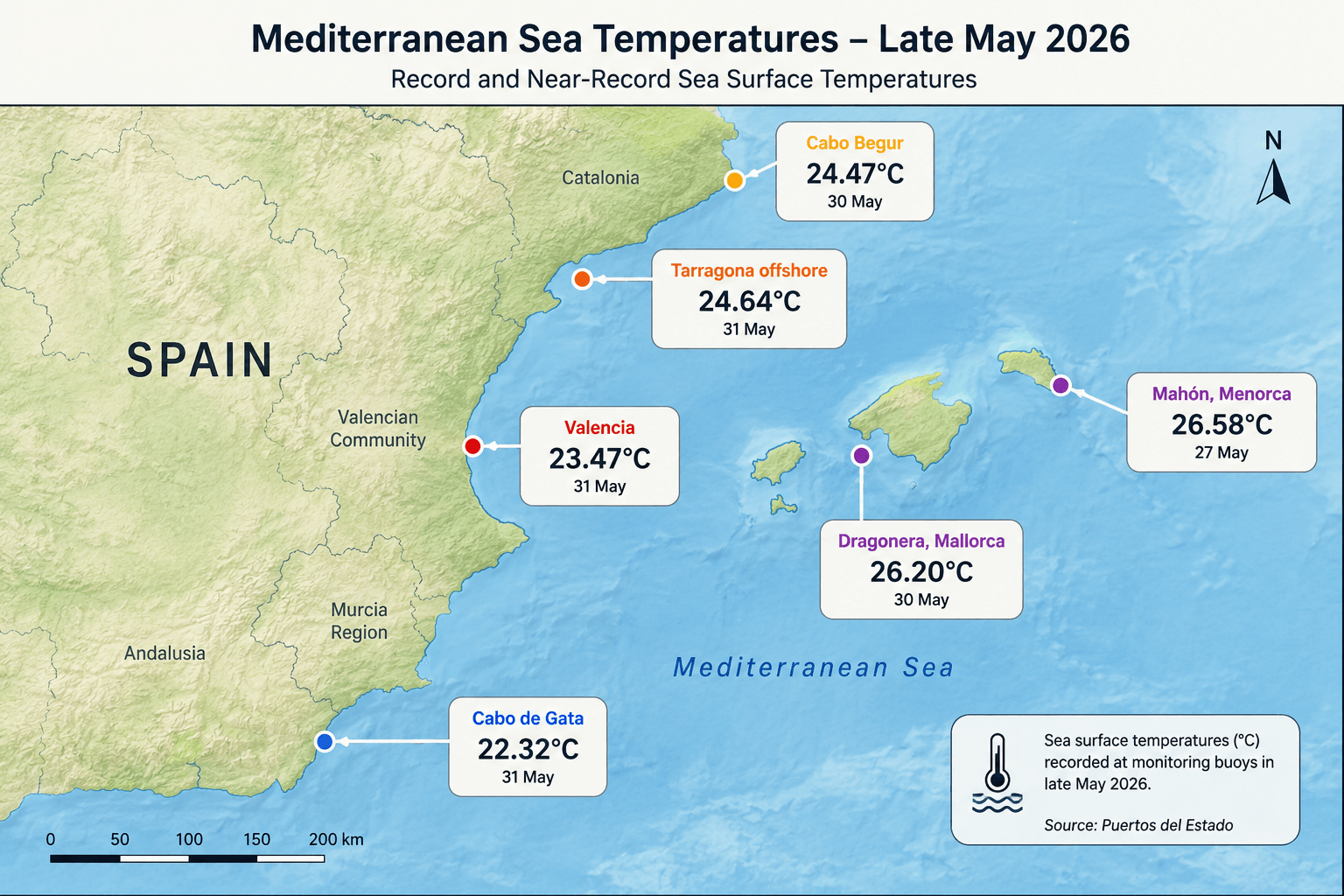
| Location | Temperature | Date |
|---|---|---|
| Valencia | 23.47°C | 31 May |
| Tarragona offshore | 24.64°C | 31 May |
| Dragonera, Mallorca | 26.20°C | 30 May |
| Mahón, Menorca | 26.58°C | 27 May |
| Cabo de Gata | 22.32°C | 31 May |
| Cabo Begur | 24.47°C | 30 May |
Puertos del Estado reported that numerous monitoring stations recorded their highest sea-water temperatures for May. The Valencia measurement is particularly significant for eastern Spain because it demonstrates just how warm the western Mediterranean had become before the main summer heating period had even begun.
It is important to remember that these are measurements from specific monitoring locations and should not be interpreted as the temperature of every beach along the Spanish coast. Sea temperature varies according to depth, currents, wind, exposure and local geography. Shallow water close to a beach can also warm considerably faster than deeper offshore water.
Nevertheless, the measurements provide strong evidence that the Mediterranean entered the summer of 2026 in an exceptionally warm state.
June brought even more Mediterranean heat
The situation became even more remarkable during June.
Satellite observations showed very large positive sea-surface-temperature anomalies across parts of the Mediterranean. An anomaly measures how much warmer or cooler the water is compared with the normal temperature for that particular location and time of year.
In late June, some parts of the Mediterranean were several degrees warmer than the long-term average. The strongest anomalies were concentrated in parts of the western Mediterranean and around areas including southern France, Corsica, Sardinia and parts of Italy.
The European Space Agency reported localised anomalies approaching 8°C above the 1991–2020 average in parts of the Mediterranean. Other Copernicus observations showed anomalies of around 6°C in parts of the western Mediterranean.
These figures need some context. An anomaly of 6°C does not mean that the entire Mediterranean was six degrees hotter than normal. It means that particular areas were approximately six degrees warmer than the historical average for that location and date.
That distinction is important because marine heatwaves are measured against the normal seasonal conditions. Water temperatures that would be perfectly normal in August can represent an extraordinary event if they occur several weeks or months earlier than expected.
The western Mediterranean has been particularly important
The western Mediterranean has been one of the areas attracting particular attention during the 2026 marine heatwave.
This includes the waters around eastern Spain, the Balearic Islands, southern France, Corsica and Sardinia, as well as surrounding areas of the western Mediterranean basin.
For Spain, this puts the Valencian coastline in an interesting position. The Mediterranean immediately east of Valencia is part of the wider western Mediterranean system, and the record May temperature recorded by the Valencia buoy shows that the exceptionally warm conditions were already affecting this part of the coast before summer had properly arrived.
However, sea temperatures can vary considerably over relatively short distances. The temperature at Gandia, for example, will not necessarily be identical to that recorded by an offshore Valencia buoy on the same day.
This is why satellite measurements and networks of coastal and offshore buoys are so valuable. Together, they provide a much clearer picture of how the temperature of the Mediterranean is changing across the entire basin.
How warm is the Mediterranean around Valencia?
For people living around Valencia, Gandia, Oliva and the wider Valencian coastline, the figures from the Valencia buoy are particularly relevant.
The 23.47°C recorded on 31 May was a May record for that monitoring location. By itself, 23.47°C might not sound particularly extraordinary during the middle of summer. The significance comes from the date.
The Mediterranean was already at a temperature that many swimmers would consider perfectly comfortable before June had even begun.
During the summer, shallow coastal waters can become warmer still, particularly during long periods of sunshine, light winds and calm conditions. Local beaches can therefore experience temperatures that differ significantly from offshore monitoring stations.
Anyone who has spent time on the Valencian coast during a prolonged period of calm weather will also know how quickly the sea can begin to feel almost bath-like.
Spain has been exceptionally hot at the same time
The warm Mediterranean is also part of a much larger weather story.
Spain has experienced exceptional heat during 2026, with AEMET reporting that July was among the hottest Julys in its historical records. June was also exceptionally warm, while spring 2026 ranked among the warmest springs recorded in Spain.
That combination is important.
The Mediterranean has been receiving intense solar heating at the same time that surrounding land areas have been experiencing prolonged periods of above-average temperatures. When hot conditions persist for days or weeks, the upper layers of the sea gradually accumulate heat.
Unlike land surfaces, which can change temperature very quickly, the sea has a huge thermal capacity. It takes considerable energy to warm such a vast body of water, but once the upper ocean has become unusually warm, it can retain that heat for a considerable period.
This gives marine heatwaves a certain persistence that ordinary weather events do not have.
Why does a warmer Mediterranean matter?
A warm sea may sound like good news for anyone heading to the beach, but unusually warm seawater has consequences far beyond swimming.
One of the most noticeable effects for people living along the coast can be increased humidity. Warmer water evaporates more readily, adding additional moisture to the air above the Mediterranean.
This can make coastal conditions feel considerably more uncomfortable during periods of high temperature. A thermometer might show a lower temperature than inland Spain, but the combination of heat and humidity can make conditions feel more oppressive.
The warm Mediterranean can also reduce the normal cooling contrast between land and sea. Normally, the sea acts as a major thermal buffer for coastal areas. During very hot weather, the Mediterranean can be considerably cooler than the land during the afternoon, helping to moderate temperatures.
When the sea itself becomes exceptionally warm, that cooling effect becomes weaker.
At night, the difference can become particularly noticeable. A very warm sea can help maintain warm and humid air near the coast, making it more difficult for temperatures to fall rapidly.
This is one reason why summer nights around the Valencian coast can feel so different from nights only a few kilometres inland.
A warm sea does not automatically mean more rain
There is also a more complicated relationship between Mediterranean temperatures and rainfall.
A warmer sea increases evaporation and provides additional moisture to the atmosphere, but that does not mean that a warm Mediterranean automatically produces rain.
Atmospheric pressure, wind direction, instability and lifting mechanisms all have to come together.
However, when the atmosphere does become unstable, the Mediterranean can provide a significant source of moisture and energy. This is particularly important for eastern Spain, where Mediterranean moisture plays an important role in some of the region’s most intense rainfall events.
That is why unusually warm sea temperatures are closely watched by meteorologists.
A warm Mediterranean does not create a DANA on its own, and it would be wrong to blame every future torrential rainfall event on sea temperatures. But exceptionally warm water can increase the amount of moisture available to an atmospheric system when the other ingredients are present.
The marine environment is also under pressure
The consequences of the marine heatwave extend below the surface.
Mediterranean ecosystems are adapted to particular temperature ranges, and prolonged periods of unusually warm water can place considerable stress on marine organisms.
Seagrass meadows, sponges, shellfish, fish, plankton and other marine organisms can all be affected when temperatures remain unusually high for extended periods.
The problem is not necessarily one exceptionally hot afternoon. It is the duration of the heat.
A short-lived temperature spike may be tolerated by many organisms. A marine heatwave lasting weeks can be considerably more damaging.
Warmer conditions can also change the distribution of marine species. Species that prefer warmer water may expand into areas where they were previously uncommon, while species adapted to cooler conditions can be pushed towards deeper or cooler water.
This can gradually change the composition of Mediterranean ecosystems.
This is not an isolated event
Perhaps the most important aspect of the 2026 situation is that the Mediterranean has not suddenly become unusually warm for the first time.
Marine heatwaves have become an increasingly familiar feature of the Mediterranean during recent years.
Copernicus data show that the Mediterranean experienced marine heatwave conditions over virtually the entire basin during successive recent years. In 2025, around half of the Mediterranean experienced severe or extreme marine heatwave conditions at some point during the year.
The 2026 situation therefore forms part of a longer pattern of exceptionally warm Mediterranean waters.
That does not mean every year will necessarily be warmer than the previous one. Natural climate variability remains extremely important, and there will still be cooler periods.
But the underlying temperature baseline has increased.
A very warm summer occurring on top of a warmer baseline can therefore produce marine heatwaves that are considerably more exceptional than similar weather events several decades ago.
The global ocean is also exceptionally warm
The Mediterranean is not operating in isolation.
The world’s oceans have also been experiencing exceptionally high temperatures during 2026.
Copernicus reported an average sea-surface temperature of approximately 20.86°C across the extra-polar global ocean during June 2026, making it the warmest June in the ERA5 record.
Copernicus Marine also recorded a daily global sea-surface temperature of approximately 21.0°C on 21 June.
July continued the exceptional run, with the average extra-polar global ocean surface temperature reaching approximately 20.96°C, the highest recorded for a July.
The Mediterranean is therefore part of a much larger pattern of unusually warm ocean temperatures.
The long-term warming of the Mediterranean
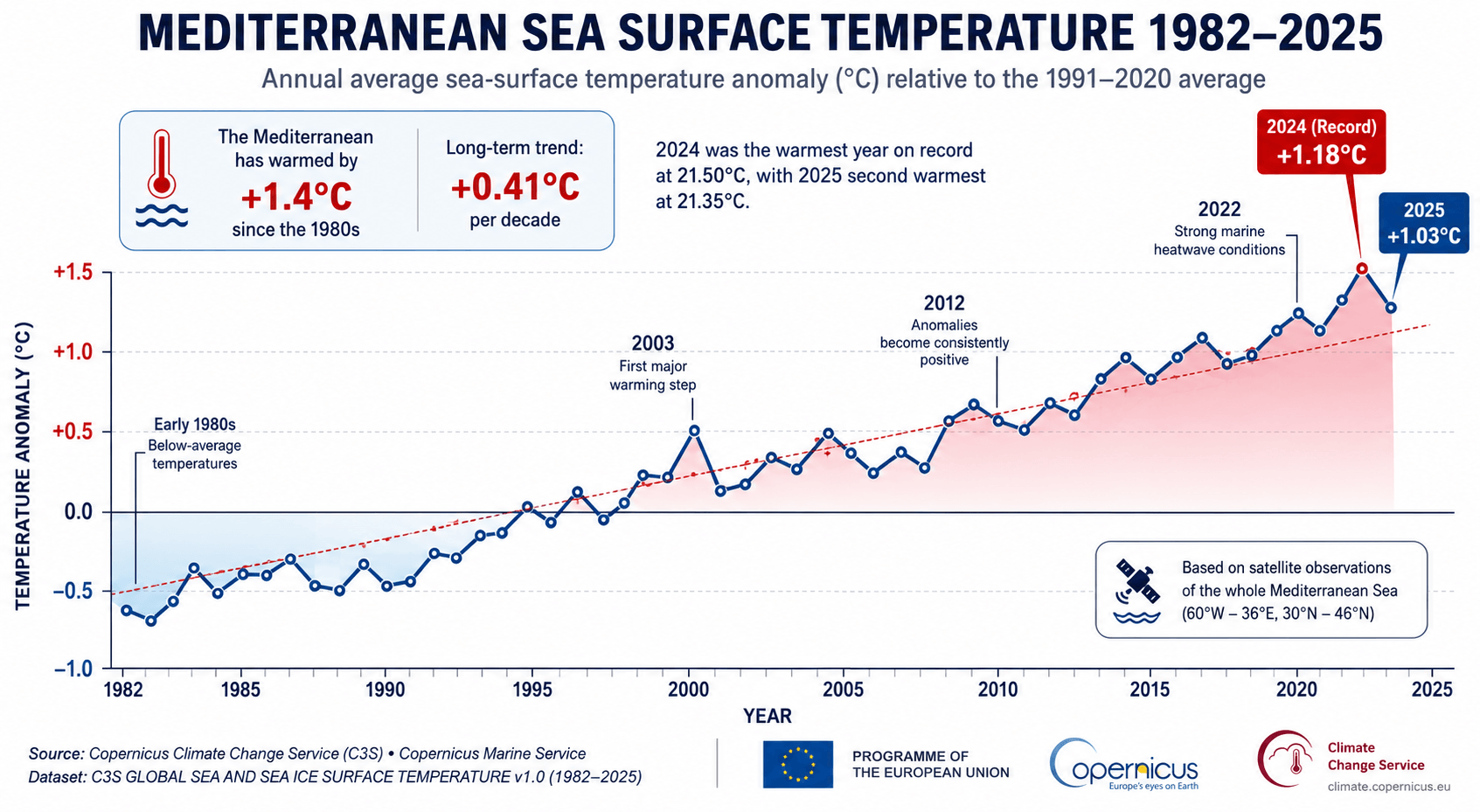
The graph shows how the Mediterranean’s average sea-surface temperature has changed over the past four decades. Although temperatures naturally rise and fall from year to year, the overall direction is unmistakable: the Mediterranean has become progressively warmer since the early 1980s. The most striking feature is the concentration of exceptionally warm years towards the right-hand side of the graph, particularly since the early 2000s. The recent period has been especially remarkable, with 2024 recording the highest annual Mediterranean sea-surface temperature in the Copernicus record at around 21.50°C, followed by another exceptionally warm year in 2025 at around 21.35°C. In other words, the exceptionally warm Mediterranean we are seeing in 2026 is not occurring in isolation; it is happening against a much warmer long-term background than existed when the records began in 1982. The year-to-year fluctuations are still important, but the underlying trend is the story the graph makes particularly clear.
What happens next?
The Mediterranean is unlikely to suddenly return to average conditions simply because the calendar has moved into August.
The sea changes temperature much more slowly than the land. After months of exceptional heat, considerable energy is stored in the upper layers of the ocean.
The important question now is how long the marine heatwave conditions persist and exactly where the strongest anomalies develop during the remainder of the summer.
Modern satellite monitoring makes it possible to follow these changes in remarkable detail. Copernicus Marine provides high-resolution Mediterranean sea-surface-temperature data, while Spain’s network of buoys provides actual measurements from locations around the coastline.
That combination of satellite observations and physical monitoring stations gives scientists an increasingly detailed picture of what is happening around Spain.
2026 is proving to be an extraordinary year
For holidaymakers, exceptionally warm Mediterranean water might simply mean that swimming is more pleasant.
For scientists, however, the story is much more significant.
The important question is not simply whether the Mediterranean reaches 25°C, 26°C or even 28°C.
It is how unusual that temperature is for the time of year, how far the temperature has moved away from the historical average, how long the anomaly persists and how large an area is affected.
In 2026, the Mediterranean has already produced remarkable figures.
Valencia reached 23.47°C in May, Tarragona reached 24.64°C, Mallorca passed 26°C, and Menorca reached 26.58°C before the end of May. Satellite observations subsequently revealed major temperature anomalies across parts of the western Mediterranean, while the global ocean continued to break temperature records.
For Spain’s Mediterranean coastline, this means that the sea is doing more than providing warm water for summer swimmers.
It is influencing coastal humidity, reducing some of the normal cooling influence of the sea, providing additional moisture to the atmosphere and placing increasing pressure on marine ecosystems.
And as August progresses, the waters around Valencia, the Balearic Islands and the rest of Spain’s Mediterranean coastline will continue to be closely watched.
2026 is already proving that the Mediterranean is not simply warm this summer. It is exceptionally warm — and the numbers tell the story.
Comments
Mediterranean Sea Temperatures Reach Record Levels in 2026 — No Comments
HTML tags allowed in your comment: <a href="" title=""> <abbr title=""> <acronym title=""> <b> <blockquote cite=""> <cite> <code> <del datetime=""> <em> <i> <q cite=""> <s> <strike> <strong>