


2026 Solar Eclipse: What You’ll See in Valencia Costa Blanca
On 12 August 2026, Spain will experience one of its most spectacular astronomical events in over a century. A total solar eclipse will cross parts of the country, attracting millions of visitors and astronomy enthusiasts eager to witness the Moon completely cover the Sun.
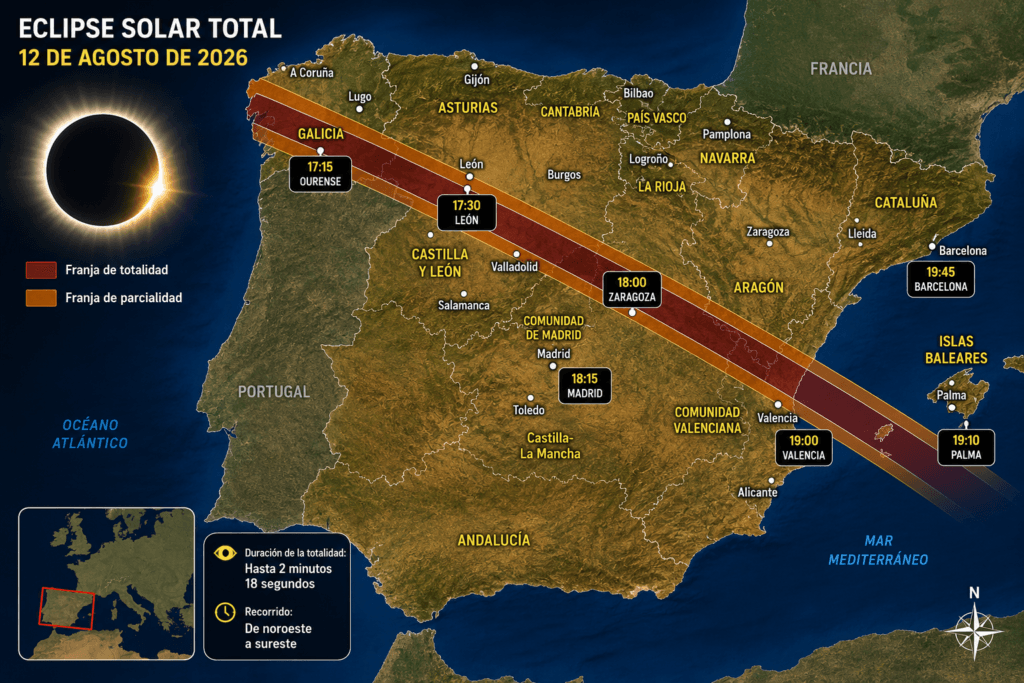
Although the path of totality will not pass directly over the Costa Blanca or Valencia region, residents and visitors in towns such as Gandia, Dénia, Jávea (Xàbia), Benidorm, Alicante and Valencia will still enjoy an impressive deep partial solar eclipse, making it one of the most memorable celestial events visible from the region for many years.
A Rare Event for Spain
The 2026 eclipse will be the first total solar eclipse visible from mainland Spain since 1905, making it a once-in-a-generation event.
The Moon will move directly between the Earth and the Sun, casting its shadow across northern Spain before continuing across Europe.
Within the narrow path of totality, the Sun will disappear completely for several minutes, allowing observers to witness the spectacular solar corona surrounding the darkened Moon.
What Will You See from the Costa Blanca?
Although Gandia and the Costa Blanca are outside the path of totality, the eclipse will still be extremely impressive.
Depending on your exact location, around 85% to 95% of the Sun will be covered by the Moon.
As the eclipse reaches its maximum, you’ll notice several unusual effects:
- The Sun will appear as a thin crescent.
- Daylight will become noticeably dimmer with an unusual silvery colour.
- Shadows will become sharper and more defined.
- Temperatures may fall by several degrees.
- Birds and insects may begin behaving as though evening is approaching.
However, because the eclipse will not be total in eastern Spain, the sky will not become completely dark, and the brilliant solar corona will not be visible.
Where Will Totality Be Visible?
Travelling north will offer a dramatically different experience.
The path of totality crosses parts of northern Spain, including areas near:
- A Coruña
- León
- Burgos
- Zaragoza (close to the eclipse path)
- Mallorca, where parts of the island will also experience totality.
Hotels and campsites within the path are expected to become extremely busy, with many astronomy enthusiasts already planning trips months in advance.
What Time Will the Eclipse Occur?
For the Valencia and Costa Blanca region, the eclipse will take place during the evening, shortly before sunset.
Although exact times vary slightly by location, the event is expected to follow this general schedule:
- Starts: around 7:30 pm
- Maximum eclipse: around 8:30 pm
- Ends: shortly before sunset
One of the most exciting aspects of the event is that the Sun will already be low in the western sky, creating fantastic opportunities for photography, especially from beaches, headlands and mountain viewpoints.
Viewing the Eclipse Safely
No matter how much of the Sun is covered, it is never safe to look directly at the Sun without proper eye protection.
Anyone watching the eclipse should use ISO 12312-2 certified eclipse glasses.
Ordinary sunglasses—even very dark ones—do not provide enough protection and can result in permanent eye damage.
Similarly, cameras, binoculars and telescopes should only be used with specially designed solar filters fitted over the front of the lens.
A Fantastic Opportunity for Photography
For photographers and videographers, the eclipse offers a rare chance to capture something truly unique.
Popular viewing locations around the Costa Blanca could include:
- Gandia Beach
- Gandia Harbour
- Les Rotes in Dénia
- Cabo de San Antonio
- The beaches around Jávea
- Santa Pola and Alicante seafront
Using a telephoto lens fitted with a certified solar filter allows you to capture the crescent Sun, while a wide-angle camera can record the changing colours of the landscape and people’s reactions as daylight fades unexpectedly.
For content creators, the event also offers an excellent opportunity to produce travel, science and tourism videos that are likely to attract international interest.
Spain’s Remarkable Eclipse Years
The August 2026 eclipse is just the beginning of an extraordinary period for astronomy in Spain.
On 2 August 2027, another total solar eclipse will cross southern Spain, with some areas experiencing one of the longest periods of totality visible anywhere in Europe.
This will be followed by an annular (ring of fire) solar eclipse on 26 January 2028, meaning Spain will host three major solar eclipses within just eighteen months.
A Must-See Event
Whether you’re an astronomy enthusiast or simply visiting the Costa Blanca on holiday, the 12 August 2026 solar eclipse promises to be one of the highlights of the year.
Although viewers in Gandia, Valencia and the Costa Blanca will not experience complete darkness, seeing up to 95% of the Sun disappear behind the Moon is still an unforgettable spectacle. Combined with the beautiful Mediterranean coastline and the warm summer evening, it promises to be one of the most memorable natural events Spain has witnessed in generations.
If you’re planning to watch the eclipse, remember to obtain certified eclipse glasses well in advance—and if you’re hoping to experience totality, start planning your trip to northern Spain early, as demand for accommodation is expected to be exceptionally high.
Comments
2026 Solar Eclipse: What You’ll See in Valencia Costa Blanca — No Comments
HTML tags allowed in your comment: <a href="" title=""> <abbr title=""> <acronym title=""> <b> <blockquote cite=""> <cite> <code> <del datetime=""> <em> <i> <q cite=""> <s> <strike> <strong>